There is a version of starting a product brand that gets told a lot, usually on LinkedIn. You find a factory, you send a picture, they quote you thirty-five days, and by spring you are shipping. It is not a lie exactly. It is just the smallest of the numbers, presented as though it were the whole thing.
Hair accessories are a useful case study, because they look like one of the simplest categories anyone could pick. Small, light, cheap to ship, no electronics, no sizing, no returns problem. Plenty of independent brands start there for exactly those reasons. And plenty of them discover, somewhere around week nine, that the simple category has a set of arithmetic nobody mentioned at the enquiry stage.
None of what follows is secret. It is just rarely volunteered.
The minimum is per design, and that word does the damage
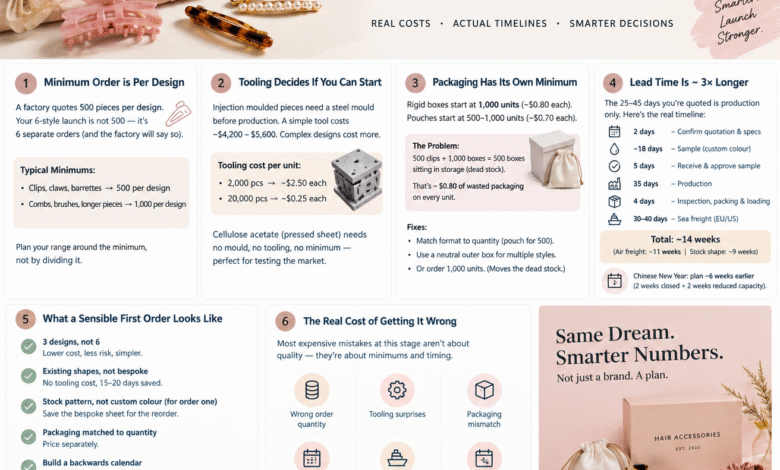
A factory quotes a minimum order of 500 pieces. The founder reads 500, thinks about a launch range of six styles, and mentally divides: roughly eighty of each. That is not a 500 piece order. That is six orders, all of them below minimum, and the factory will say so.
The reason is not obstinacy. Every design change means the machine stops, the tooling or the pattern is swapped, the first pieces off the line are checked and scrapped, and the operator re-learns the piece. That setup cost is the same whether it is followed by eighty pieces or eight hundred. Below a certain run length the setup is most of what you are paying for.
The practical consequence is that a range gets planned around the minimum, not divided by it. A three-style launch at 500 each is 1,500 pieces and a real order. A six-style launch at 500 each is 3,000 pieces, and that is a different amount of money and a different amount of unsold stock risk than most first-time founders have modelled.
Worth knowing: the number moves by category rather than by negotiation. Clips, claws and barrettes typically sit at 500 per design. Combs, brushes and longer pieces sit at 1,000, because they take substantially more finishing labour per unit. If a supplier quotes you 300 on everything without asking what the product is, that tells you something about the supplier.
Tooling is the question that decides whether you can start at all
This is the fork in the road, and it arrives before you have spent anything.
If a piece is injection moulded — most cheap plastic accessories are — it needs a steel mould cut for it before a single unit exists. A straightforward one runs somewhere around USD 4,200 to 5,600. Anything with undercuts, side actions or several components multiplies that, and any supplier quoting a complex tool from a photograph rather than a 3D file is guessing at a number they will revise upward later.
That cost is not per unit, which sounds reassuring until you divide it. Spread a USD 5,000 tool across 2,000 pieces and it adds USD 2.50 to every one — often more than the piece itself. Across 20,000 it adds twenty-five cents and stops mattering. Tooling is not expensive or cheap in itself; it is expensive at small volumes and irrelevant at large ones, and where your first order sits on that curve decides whether the maths works.
Which is why the alternative matters more than it is usually given credit for. Cellulose acetate — the material behind almost everything that looks like tortoiseshell or marble — is not moulded at all. It arrives as pressed sheet with the pattern built through it, and pieces are cut out and polished. No mould, therefore no tooling bill, therefore no minimum imposed by the need to amortise steel. For a brand still finding out whether anyone wants the product, that difference is the whole business case. Most hair accessory manufacturing quotes will not point this out unless you ask, because the tooling line is revenue.
Packaging has its own minimum, and it will not match yours
This is the one that catches almost everybody, because it appears late.
Rigid boxes — tuck-end cartons, drawer boxes, clear PET — generally start at 1,000 units and around USD 0.80 each. A steel rule die has to be cut for one specific box size, which is why the floor sits where it does. Pouches, being sewn rather than die-cut, start lower, around 500 to 1,000 and roughly USD 0.70.
So: you order 500 clips, at the 500 piece product minimum, and specify a rigid box. You have just bought 1,000 boxes. Five hundred of them will sit in a warehouse until you either reorder or give up, and their cost lands on the 500 units you actually sold. That is about USD 0.80 of dead packaging on every single unit, which on a modest first order can quietly halve the margin in your spreadsheet.
There are three fixes and they are all boring. Match the format to the quantity — a pouch at 500 lines up with a 500 piece order. Or keep the outer box design-neutral so one run of 1,000 carries two different 500 piece styles, which is the most common answer and costs nothing to plan for. Or commit to 1,000 units of product, which only moves the dead stock rather than removing it. Whichever you pick, quote packaging as its own line, never bundled, so you can see what it is doing.
The lead time you were quoted is about a third of the real one
“Twenty-five to forty-five days” is a production figure. It is the time the goods spend being made. It is not the date the stock is sellable, and the gap is where launch calendars die.
A realistic calendar for a first order looks closer to this. Two days to confirm quotation and specification. Around eighteen days to make a sample if the colour is custom, because the acetate sheet has to be pressed for you before anything can be cut from it. Five days for you to receive it, look at it properly and sign it off — this block is yours, and it is the one buyers most often blow. Then thirty-five days of production, four days of inspection, packing and loading, and thirty to forty days of sea freight to a European or American port.
That is roughly fourteen weeks from first enquiry to goods on your shelf. The thirty-five days you were quoted is a third of it. Air freight instead of sea brings it to about eleven weeks at considerably more cost. Choosing an existing shape in a stock pattern — no new tooling, no custom sheet pressing — brings it to about nine, and is far and away the cheapest lever available.
One date overrides all of this. Chinese New Year shuts factories for two to four weeks and the fortnight either side runs at reduced capacity, so anything landing in that window needs to be ordered roughly six weeks earlier than the calendar suggests.
What a sensible first order actually looks like
Put those constraints together and the shape of a low-risk launch is fairly well determined.
Three designs rather than six. Existing shapes rather than bespoke ones, which removes the tooling cost and fifteen to twenty days at the same time — the range of wholesale hair clips and barrettes a factory already has dies for is usually far wider than the first email suggests, and picking from it is not a compromise so much as a sequencing decision. A stock pattern rather than a custom-pressed colourway for order one; save the bespoke sheet for the reorder, when you know which style sold. Packaging matched to the quantity, priced separately. And a calendar built backwards from the date you need stock, with freight in it.
That order will be less exciting than the one in your head. It will also still exist in eighteen months, which is more than can be said for the six-style bespoke launch that spent its entire budget on tooling and boxes before finding out which style anyone wanted.
The unglamorous truth about manufacturing is that nearly every expensive mistake at this stage is a scheduling or minimum-order mistake rather than a quality one. Those are the cheapest kind to avoid, because avoiding them costs nothing but asking.