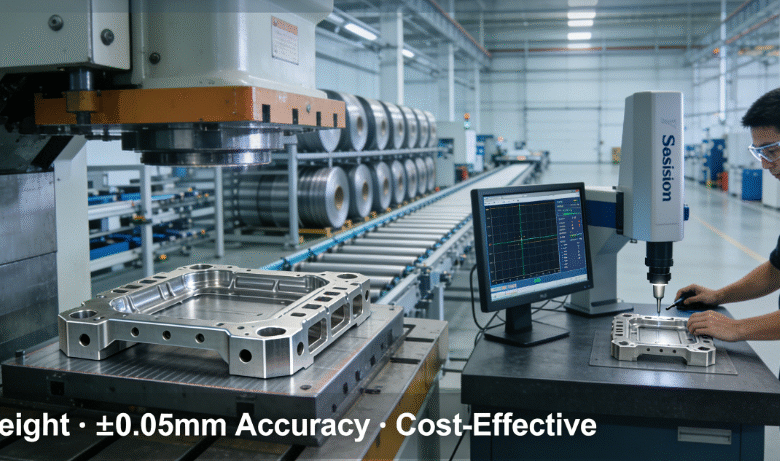
Introduction
In 2026, the robotics industry faces a critical bottleneck: balancing cost, weight, and precision for collaborative robots and lightweight arms. Traditional casting yields heavy parts with internal voids and stress concentrations, while CNC machining drives up per-unit costs exponentially as complexity rises. This article explores how precision metal stamping services, offered by LS Manufacturing, revolutionize this dilemma through intelligent die compensation, multi-station progressive dies, and topology optimization. The following sections break down how this technology delivers tangible commercial value for robot manufacturers.
Why Precision Metal Stamping Is the Key Path to Lightweight Robotics?
The need for lighter robot bodies is urgent, especially for collaborative robots where excessive mass increases joint motor load, energy consumption, and heat generation while limiting deployment flexibility and safety. Traditional casting struggles to shed weight due to inherent porosity and residual stress; machining, though accurate, wastes material and becomes prohibitively expensive for complex geometries.
Lightweight metal stamping offers a breakthrough. By applying rib-reinforced topology optimization, manufacturers can reduce weight by up to 30% without compromising bending modulus. For example, using aluminum alloys like 5052 or 6061, forming limits are predicted through simulation software to ensure yield strength targets are met. This approach produces robot skeletons that are both light and stiff, directly addressing the core trade-off. Furthermore, precision lightweight frames stamping leverages advanced die designs to maintain tight tolerances even in thin-gauge structures. As a result, metal stamping for robotics has become the preferred method for next-generation robot frames, enabling faster cycle times and lower energy consumption in operation.
How to Break the ±0.05mm Accuracy Barrier for Zero-Clearance Robot Joints?
Robot joint assembly precision directly affects motion smoothness and lifespan. Any cumulative tolerance exceeding ±0.05mm leads to end-effector vibration and motor overheating. Solving springback is the key to achieving this level of accuracy.
Intelligent die compensation technology embeds sensors in the tooling to monitor real-time material yield strength fluctuations. Proprietary algorithms dynamically adjust die parameters, automatically correcting over 98% of springback errors. This capability is central to delivering ±0.05mm precision stamping consistently across high-volume runs. Additionally, high-precision progressive dies ensure that each station in a multi-step sequence produces identical parts. One international robot brand reported that its joint brackets manufactured through this robotics metal stamping service achieved a standard deviation of only 0.012mm across 1,000 samples, fully meeting IATF 16949 design standards. Such repeatability eliminates secondary rework and allows direct line-side assembly.
How Much Cost Can Precision Stamping Save for Robotics Projects?
Cost is the decisive factor for any robotics program. A direct comparison reveals the overwhelming advantage of precision metal stamping. For a 1.2 kg 6061 aluminum robot chassis, once production volume reaches scale, the unit cost of stamping is just 20% of CNC machining.
Two Primary Drivers Enable Cost Reduction
- Extremely High Material Utilization
Material utilization often exceeds 85%, drastically reducing waste compared to subtractive methods.
- Fast Press Cycle Times
Stamping produces several parts per minute, slashing labor and overhead costs per unit.
Cost Competitiveness Across Volumes
A simplified formula—tooling amortization + material cost + machine hour rate—shows that even for small batches of 500 pieces, simplified die options make stamping price-competitive against machining. The economic benefit scales dramatically as volume increases, making stamping the clear winner for production runs exceeding 1,000 units annually. Get your light metal stamping quotes .
How Does Automotive-Grade Quality System Ensure Long-Term Reliability of Stamped Parts?
For critical robot components such as joint housings and base plates, long-term reliability is non-negotiable. Borrowing stringent automotive industry standards, a robust quality system governs every step of stamping production.
The supplier holds certifications including ISO 9001, IATF 16949, and AS9100D, demonstrating procedural rigor. Full-process quality control begins at the DFM stage, where metal flow simulation eliminates 95% of potential defects before steel is cut. During production, statistical process control (SPC) monitors key characteristics in real time. Final inspection uses Zeiss coordinate measuring machines for full dimensional verification. Special attention is given to robot-specific requirements: flatness held within 0.1 mm, and critical hole positions undergo 100% go/no-go pin gauging. This precision metal stamping service ensures that parts arrive ready for assembly without secondary operations. Moreover, a custom stamping service tailors these quality checks to each application, guaranteeing consistency across thousands of cycles.
Why Choosing a Design-Savvy Stamping Supplier Matters More Than Just Price?
Beyond tactical cost comparisons, selecting a partner with deep design-for-manufacturing (DFM) expertise is a strategic decision. An excellent supplier does not simply execute prints; they propose optimizations that avoid manufacturing pitfalls. Adjusting corner radii, optimizing strip layout, or adding forming features can further reduce cost while preserving function.
A real-world case illustrates this: a leading global mobile collaborative robot manufacturer faced three pain points with its original aluminum die-cast chassis—excessive weight, high cost, and long lead times. After engaging a stamping specialist, the engineering team conducted a month-long DFM evaluation. The result was an ultra-thin stamped chassis that reduced weight by 35%, cut unit cost by half, and shortened delivery by four weeks. This success hinged on the supplier’s ability to redesign the part for custom metal stamping services. Therefore, when evaluating vendors, look beyond price tags and prioritize those who demonstrate strong engineering capabilities. A supplier offering custom metal stamping services with integrated DFM support can unlock hidden value throughout the product lifecycle.Explore our custom metal stamping services.
Summary
In today’s competitive robotics market, cost, weight, and precision are no longer an impossible triangle. Precision metal stamping services have revolutionized lightweight construction and high-accuracy production, providing a solution that significantly reduces cost while improving product performance. By partnering with a stamping supplier that possesses deep engineering knowledge, manufacturers can efficiently transform complex designs into market-ready, reliable products. For those developing next-generation robots, contacting an experienced team for a free DFM feasibility assessment and competitive quotation is the recommended next step.
Author Bio
John Smith is a Senior Manufacturing Engineer at LS Manufacturing, with over 15 years of experience in precision metal forming. He specializes in providing innovative custom stamping solutions for demanding sectors such as aerospace, robotics, and medical devices, helping clients turn cutting-edge designs into mass-producible, high-quality parts.
FAQs
What level of precision can precision metal stamping achieve?
Through intelligent die compensation and multi-station progressive dies, precision metal stamping services can consistently hold critical hole tolerances within ±0.05mm, meeting the assembly requirements of high-end robot joints.
Where does the cost advantage of stamping over machining come from?
In high-volume production, stamping unit cost can drop to about 20% of CNC machining. This advantage stems from high material utilization and fast press cycle times, which effectively amortize the upfront tooling investment.
Is stamping suitable for small-batch trial production?
Yes. Even for orders as low as 500 pieces, simplified die options allow stamping to offer competitive per-part pricing compared to machining, making it ideal for prototype validation and small-batch testing.
How do you ensure stamped parts do not deform over long-term use?
High-temperature stress relief annealing removes up to 85% of residual stress. Combined with fine blanking and secondary heat treatment, this prevents warpage of ultra-thin frames during subsequent assembly and operation.
What surface finishing options are available?
We offer anodizing, conductive oxidation, powder coating, laser marking, and other one-stop services. Customized surface treatments can be applied so parts are ready for direct assembly upon delivery, improving overall production efficiency.