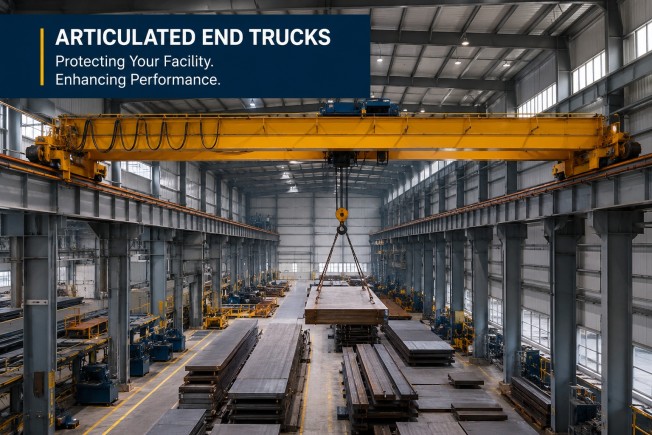
When a company builds or leases a heavy manufacturing plant, the structural steel frame of the facility is treated as a permanent asset. It is engineered to stand for decades, resisting wind, seismic shifts, and the dead weight of the roof. However, inside facilities that utilize high-capacity overhead crane systems, that steel frame is subjected to a relentless, aggressive force that building designers often struggle to fully neutralize: crane skewing. Every time an overhead crane accelerates, brakes, or carries an off-center load, it exerts massive horizontal forces against the runway beams. Over time, these dynamic forces can slowly bend, twist, and degrade the very building that supports them.
The Destructive Physics of Crane Skew
The fundamental challenge with large bridge cranes lies in their dual-drive architecture. A massive steel bridge spans the width of the factory floor, supported at each end by a structure traveling along an elevated runway. Ideally, both sides of the crane move at the exact same speed, keeping the bridge perfectly perpendicular to the tracks.
In reality, perfect alignment is a mechanical impossibility. Slight differences in motor timing, uneven wheel wear, or a heavy payload positioned closer to one side of the bay will cause one end of the crane to lead or lag behind the other. When this happens, the crane twists out of square, a phenomenon known as skewing.
As a skewed crane forces its way down the runway, the wheel flanges slam violently against the sides of the track. This creates an intense binding force. Instead of moving smoothly down the line, the crane jams itself between the runways, generating massive lateral thrust forces. Because the runway beams are directly bolted or welded to the facility’s structural columns, these immense forces are transferred directly into the building’s skeleton, pulling columns out of plumb and loosening critical structural connections.
The Illusion of the Rigid System
Historically, the engineering response to crane skewing was to make everything heavier and more rigid. Manufacturers built massive, unyielding end trucks designed to box the crane into a square position through sheer structural mass.
While this rigid philosophy might seem effective on paper, it completely ignores the laws of structural physics. When a crane cannot flex, the internal stresses have nowhere to go. The rigid assembly acts as a massive lever, amplifying the skewing forces and driving them deeper into the runway structure. This creates a highly destructive feedback loop. The rigid crane warps the runway rails over time; the warped rails then cause the crane to skew even more severely, accelerating wheel wear, burning out drive motors, and cracking structural welds along the building’s crane brackets.
The Power of Mechanical Articulation
To break this cycle of destruction, modern industrial designers are shifting away from rigid constraints and embracing mechanical articulation. Instead of trying to force a crane to stay perfectly square through brute strength, articulated end trucks utilize built-in pivot points and spherical bearings that allow for controlled, micro-flexibility.
When an articulated system encounters a track misalignment or an off-center load, the end truck can pivot independently of the bridge structure. This small mechanical adjustment allows the wheels to naturally realign themselves with the rail, completely eliminating the binding action that characterizes rigid systems. By allowing the crane to accommodate track imperfections rather than fighting them, articulation reduces lateral thrust forces by up to fifty percent. The crane rolls smoothly, the wheel flanges stop grinding against the rail, and the structural columns of the building are relieved of the destructive twisting forces.
Optimizing Kinetic Efficiency
Transitioning to an articulated infrastructure requires a comprehensive look at the entire moving assembly. It is not enough to simply articulate the large end trucks that move the bridge; the smaller carriers that move the hoist across the bridge must also be optimized for precision tracking.
[Rigid Crane Assembly]  --> Binds on Tracks --> Transfers Lateral Shock to Building
[Articulated Assembly]  --> Pivots on Turns --> Absorbs Shock, Keeps Wheels Aligned
In high-duty cycle environments, the smooth transition of material requires a perfectly balanced synergy between the primary bridge movement and the lateral hoist travel. Utilizing a heavy-duty truck trolley system built with high-tensile flangeless wheels and side-guiding rollers ensures that the hoist moves across the bridge with zero binding. When combined with articulated end trucks, this integrated layout ensures that every moving component adjusts automatically to the kinetic pressures of the load. This prevents localized stress spikes and ensures the path of material flow remains fluid, efficient, and entirely safe.
Protecting the Lifecycle of the Asset
In 2026, operational resilience is the defining metric of industrial success. A facility cannot afford to halt production because a skewed crane has chewed through its wheels or warped a runway rail. The long-term costs of a rigid material handling philosophy—manifesting as constant wheel replacements, structural welding repairs, and building structural remediation—are completely unsustainable.
Investing in articulated overhead infrastructure is a proactive strategy that treats the building and the crane as a single, co-dependent ecosystem. By allowing your machinery to adapt to the physical realities of motion, you protect the structural integrity of your facility, slash your maintenance overhead, and provide a safer environment for your frontline team. True engineering excellence is not about building things so rigid that they shatter under pressure; it is about designing systems smart enough to flex, pivot, and endure.